How lead markets can help transform Europe’s chemical sector
Green lead markets are vital to transforming the chemical sector, but which sectors hold the most promise? As a first step, we identified three market clusters – yet scaling lead markets also requires strong investment signals and policy frameworks
-
 Florie Gonsolin
Europe’s chemical industry is a cornerstone of the European Unions’ competitiveness, and resilience and a key lever for achieving climate objectives. Yet, current geopolitical upheavals are posing significant challenges – driven by persistently high energy and raw material prices and weakening demand from key customer sectors. To stay competitive, the industry needs to pivot towards innovation, security of supply and high-quality jobs while transitioning to climate neutrality. Driving this transformation requires significant investment, which must be underpinned by a strong business case, including stable and predictable demand for cleaner chemical products.
Identifying lead markets: scale, strategy and feasibility
To enable a large-scale transformation of the chemical sector, green lead markets are indispensable. These markets create early, credible and scalable demand for sustainable chemicals. But identifying the right markets is complex.
Agora Industry, in collaboration with Systemiq, analysed which end-markets can best serve as lead markets for sustainable chemicals across both private markets and public procurement. The central question: which markets are best positioned for this role? To find out, we looked at three dimensions:
- Scale – does the market have the necessary volume and value to drive industrial transformation? A high share of chemical offtake is essential to create the credible demand required to scale up sustainable production capacities.
- Strategy – how well does the sector align with broader European goals? This means looking at economic value added, employment, greenhouse gas emission reduction potential and the role of critical supply chains in reducing import dependencies.
- Feasibility – can the lead market measures actually be implemented? This comes down to whether end-products can absorb green cost premiums while staying competitive, whether policy frameworks can be effectively enforced and whether there is sufficient political and industrial backing for the transition.
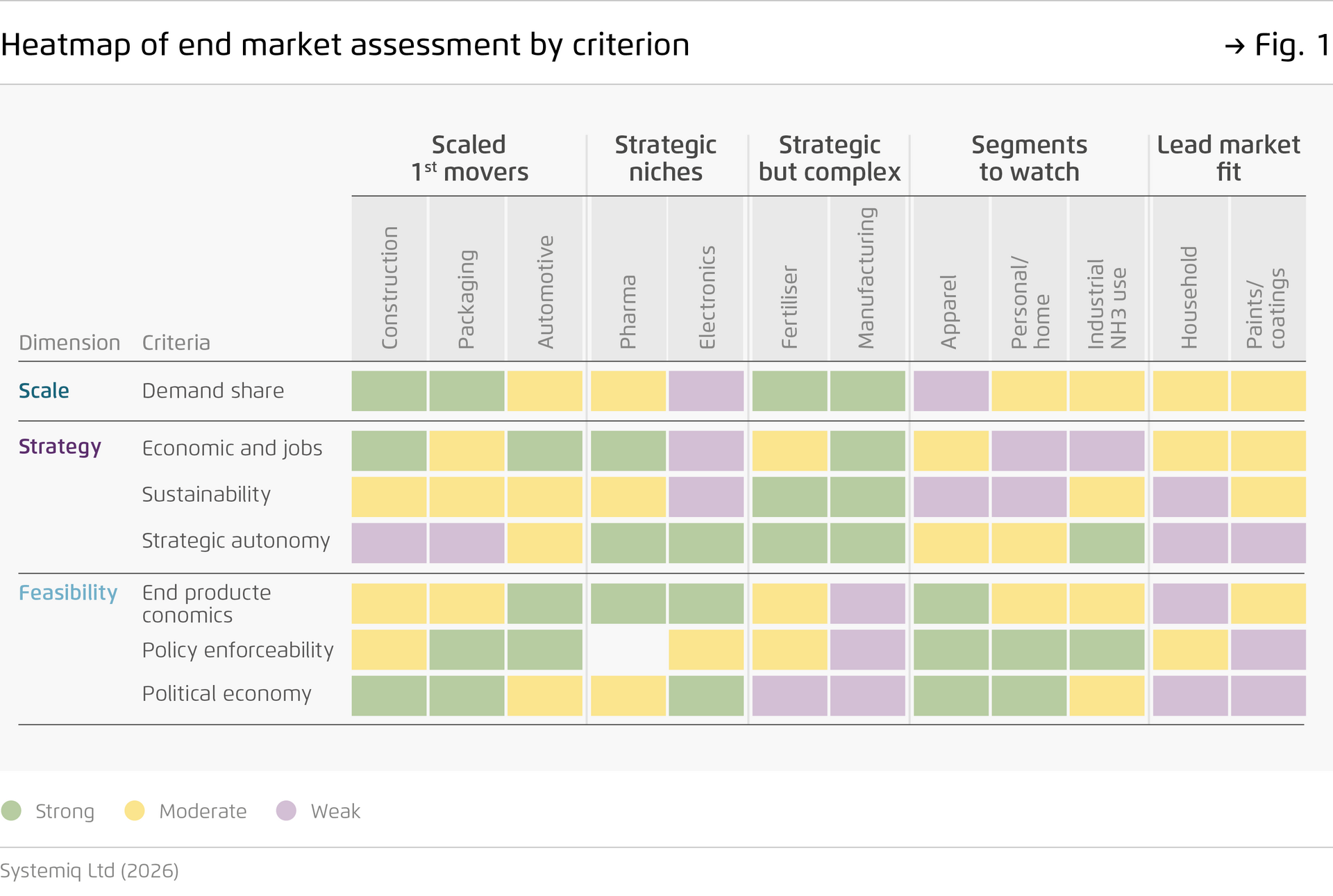
When looking into these three dimensions, we conclude: while no single cluster of end-markets meets all criteria perfectly and strategic trade-offs remain, there are three primary rationales for prioritising potential lead markets. First, sectors like construction, packaging and automotive could serve as first movers because they combine scaled offtake with feasibility. Second, pharmaceuticals and electronics could be prioritised due to their high strategic value and feasibility, even if they have limited scale. Third, sectors like fertiliser and manufacturing (solvents, adhesives, lubricants and other B2B specialty chemicals) offer strategic value and scale but come with customer fragmentation and feasibility barriers. Ultimately, upcoming lead market policies will need to carefully balance these priorities to turn potential lead markets into a reality.
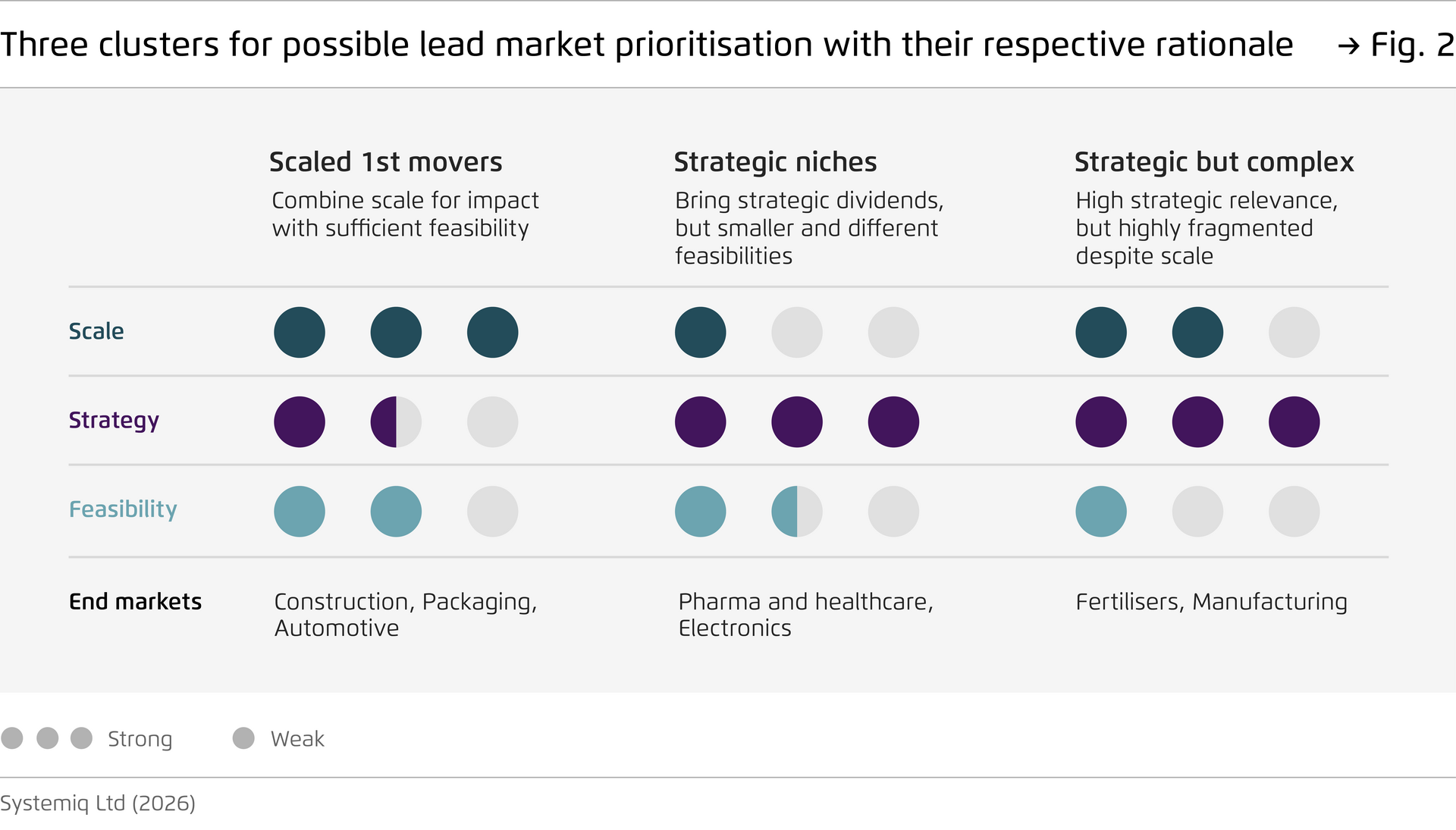
Identifying and prioritising possible lead markets is just the first step. To drive forward their implementation, further steps are needed. These include a more granular analysis of their potential implementation at product level and the development of a lead market policy toolkit. Critically, the proposed measures must provide meaningful signals for investors’ confidence and economic viability to succeed. These should be part of a wider transition framework for the sector that includes a strong EU emissions trading system (EU ETS) and further enablers like access to clean energy and affordable non-fossil feedstock.
This work was developed within the “Critical Chemicals Alliance”, of which Agora Industry is a member. The Alliance was established in July 2025 under the European Commission’s Chemicals Industry Action Plan. Its goal is to address the sector's most pressing issues, such as trade challenges, while supporting modernisation and investment in critical production capacities.